
FREE Shipping For Orders Over CA$400  |  10% Off Your First Order: GAINS10

Bearded man sitting on his bed with a hand on his head, thinking about whether masturbation lowers testosterone

Does Masturbation Lower Testosterone?

It is one of the most persistent claims in men’s health forums: that masturbation drains testosterone, and that abstaining raises it. The claim gets repeated so often that it is treated as settled. The research tells a much less dramatic story.

Here is what the studies actually show.

The Short Answer

There is no good evidence that masturbation lowers testosterone in any lasting way. Studies have found short-term fluctuations around sexual activity and abstinence, but nothing showing that regular masturbation reduces baseline testosterone over time.

Where the Idea Comes From

The claim has a few sources, and most of them are a reasonable observation stretched too far.

A well-known abstinence study. A small study published in 2003 tracked testosterone in men abstaining from ejaculation and reported a peak around day seven, at roughly 45 percent above baseline, before levels returned to normal. That single study is the source of much of the “abstain to boost testosterone” idea.

Sexual arousal raises testosterone briefly. Some research has found that sexual arousal and activity can produce short-lived increases in testosterone, which complicates the picture rather than supporting the drain theory.

Post-orgasm hormonal shifts. Prolactin rises after orgasm, and prolactin can affect sexual desire and refractory period. That is sometimes misread as a sign that testosterone is being used up.

Online abstinence movements. Communities built around abstaining have spread the claim widely, often presenting the day-seven finding as if it meant permanently higher levels.

What the Research Actually Shows

ClaimWhat the evidence suggests
Masturbation lowers testosteroneNo good evidence of a lasting effect
Abstinence raises testosteroneA short-term peak in one small study, then a return to baseline
Long-term abstinence keeps levels highNot supported by the available research
Sexual activity uses up testosteroneNot how testosterone production works

The day-seven peak is the most interesting finding, and also the most misread. It was a temporary fluctuation, not a new baseline. Levels went back to normal, and the study did not show that abstaining produces any lasting benefit.

How Testosterone Is Actually Regulated

Testosterone production is controlled by a feedback loop running from the hypothalamus to the pituitary to the testes. The hypothalamus releases GnRH, the pituitary releases LH, and LH tells the testes to produce testosterone.

That system responds to overall hormonal signals, not to ejaculation as a kind of withdrawal from a reserve. Testosterone is not a stored supply that sexual activity depletes. It is produced continuously and regulated to stay within a range. How that system responds to outside influences is covered in How to Use Steroids Without Destroying Your Natural Testosterone.

What Does Affect Testosterone

If the goal is understanding what moves testosterone levels, the factors with real evidence behind them are much more ordinary:

  • Sleep. Restricted sleep is associated with lower testosterone.
  • Body fat. Higher body fat is associated with lower testosterone, partly through increased aromatase activity.
  • Training. Resistance training can have short-term effects on testosterone, and overall training habits influence body composition. The training side is covered in The Science Behind Progressive Overload and Muscle Growth.
  • Age. Testosterone declines gradually with age.
  • Chronic stress and illness. Both are associated with lower levels.
  • Exogenous hormones. Taking testosterone or other androgens suppresses natural production.

Those are the variables that show up consistently in research. Masturbation is not among them.

What Actually Shuts Testosterone Down

For readers of this site, the factor that dwarfs everything else on the list is exogenous hormones. Adding testosterone or other androgens from outside tells the body to stop producing its own, and natural production can stay suppressed for some time after use ends.

That suppression is measurable, substantial and well documented, which is the opposite of the masturbation claim. It is also the reason recovery after a cycle gets so much attention, covered in Why Post Cycle Therapy Is Essential.

What Low Testosterone Actually Looks Like

Concerns about masturbation often come from men who feel tired, flat or low in libido and are looking for a cause. Those symptoms can be associated with low testosterone, but they are also common with poor sleep, stress, low mood and many other conditions.

The only way to know whether testosterone is actually low is to test it, ideally more than once. Assuming a cause from symptoms alone, in either direction, is how people end up chasing the wrong problem. Questions about how testosterone relates to TRT and to non-medical use are part of the wider discussion in How to Use Steroids Without Destroying Your Natural Testosterone.

Timing Matters If You Are Getting Tested

One practical point: testosterone follows a daily rhythm and is usually highest in the morning. Blood tests for testosterone are typically taken in the morning for that reason, and a single reading can vary from day to day.

That variability is one reason short-term claims about any single factor, masturbation included, are hard to judge from one test. What a panel can and cannot tell you is set out in What Bloodwork Actually Tells You During a Cycle.

Where Mental Health Fits In

Some of the claims around abstinence are really about mood, motivation and self-control rather than hormones. Those are real things for the people who report them, but they are a different question from testosterone levels. The relationship between hormones, training and mood is covered in Mental Health, Steroid Use, and Seasonal Stress.

It is also worth remembering that testosterone has a normal range, and that range is wide. Two healthy men can have very different readings without either being low, which is another reason a single number, or a single habit, rarely explains how someone feels.

The Short Version

Masturbation does not appear to lower testosterone in any lasting way. One small study found a short-lived peak after about a week of abstinence, followed by a return to normal, and that finding has been stretched into a much bigger claim than it supports. Sleep, body fat, age, stress and exogenous hormones have far more influence on testosterone than sexual activity does. Questions about specific products are answered in the FAQ.


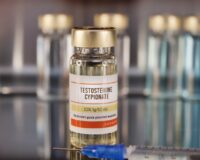
Vial of testosterone cypionate beside a syringe, illustrating the difference between TRT and anabolic steroids

Is TRT the Same as Steroids?

TRT and steroids get talked about as if they were opposites: one medical and legitimate, the other not. Chemically, the line is much thinner than that. Testosterone replacement therapy uses testosterone, and testosterone is an anabolic steroid. The differences that matter are about purpose, amount, monitoring and the law.

Here is what actually separates the two.

The Same Molecule

Testosterone is the original anabolic androgenic steroid. Every other compound in the class is either testosterone itself or a modified version of it. So the simple answer to the question is yes: TRT is steroid use, in the sense that it involves taking a steroid hormone.

The testosterone used in TRT is also the same testosterone discussed everywhere else on this site. Cypionate and enanthate, the two most common injectable esters, are standard in both settings. How esters work is covered in Popular Steroid Esters Explained.

Where TRT and non-medical steroid use part ways is in why the hormone is being used and how much of it.

The Purpose Is Different

TRT exists to treat hypogonadism, a condition where the body does not produce enough testosterone on its own. The goal is to bring testosterone back into the normal physiological range and relieve the symptoms of being below it.

Non-medical use generally aims for levels above that range, to push muscle growth, strength or recovery beyond what normal physiology supports. That goal is what drives most of the other differences.

The Key Differences at a Glance

TRTNon-medical steroid use
GoalRestore normal testosterone levelsExceed normal levels
CompoundsTestosterone only, in most casesOften several compounds
PrescribedYes, after diagnosisNo
MonitoringRegular bloodwork by a clinicianVaries, often none
Legal status in CanadaLegal with a prescriptionPossession without a prescription is an offence

Amount Changes Everything

Because TRT targets the normal range, it involves much less hormone than most non-medical use. That matters because many of the effects people associate with steroids scale with exposure.

Higher androgen levels raise the likelihood and severity of effects such as suppressed natural production, raised haematocrit, changes in blood pressure and cholesterol, and androgenic effects on skin and hair. TRT is not free of these effects, but at physiological levels they are generally more manageable and more closely watched. The blood pressure side of this is covered in Blood Pressure on Cycle.

What a TRT Diagnosis Usually Involves

TRT is not normally started on the strength of a single blood test or a list of symptoms. Clinical guidelines generally call for both: symptoms consistent with low testosterone, and low testosterone confirmed by blood tests, usually taken in the morning when levels are highest and usually repeated on more than one occasion.

That matters because testosterone varies from day to day and across the day, and a single low reading can be a poor night’s sleep, an illness or an unusual week rather than a lasting problem. A clinician will also usually look for underlying causes before treating the number itself, since low testosterone can be secondary to other conditions.

The result is that someone on TRT has, in principle, a documented reason for being on it, a measured starting point and a target. That documented starting point is one of the clearest practical differences from non-medical use, where the starting point is often never measured at all.

Monitoring Is a Real Difference

Someone on TRT is normally tested before starting and at intervals afterwards. A clinician watches testosterone, estradiol, haematocrit, lipids and other markers, and adjusts treatment if something moves too far.

That monitoring is a large part of what makes TRT medical rather than just a smaller amount of the same thing. The same panels are useful outside a medical setting, and what they show is set out in What Bloodwork Actually Tells You During a Cycle.

TRT Still Suppresses Natural Production

One thing TRT has in common with any other testosterone use is suppression. Adding testosterone from outside tells the body to make less of its own, so natural production falls.

That is why TRT is usually treated as long-term or ongoing rather than as a short course, and why fertility is part of the conversation for anyone considering it. The mechanics of suppression are covered in How to Use Steroids Without Destroying Your Natural Testosterone.

The Forms TRT Comes In

TRT is not only injections. Depending on the patient and the prescriber, testosterone can be delivered as an intramuscular or subcutaneous injection, a topical gel or cream, or in some markets an oral or implanted form. Each produces a different pattern of levels over time, and the choice affects how steady those levels are between doses.

Non-medical use leans heavily on injectables, where the compound options are broader. The trade-offs between routes are covered in Oral vs. Injectable Steroids.

Why People Confuse the Two

A few things blur the line in everyday conversation.

Clinics advertising TRT. Some clinics market TRT around energy, physique and performance, which makes it sound closer to non-medical use than a strict medical definition would.

Doses at the top of the range. TRT aims for the normal range, but that range is wide, and treatment that targets the top of it can look different from treatment that targets the middle.

Shared compounds. The same esters, and sometimes the same supporting compounds such as aromatase inhibitors from the AE and PCT range, appear in both settings.

The Legal Position in Canada

Testosterone is a Schedule IV controlled substance under the Controlled Drugs and Substances Act. With a valid prescription, possession and use are legal. Without one, possession is an offence, and importation and trafficking are treated considerably more seriously.

So the same vial can be legal for one person and not for another, depending on whether it was prescribed. How enforcement works in practice is covered in How Canada Enforces Anabolic Steroid and SARM Laws.

So, Is TRT the Same as Steroids?

Chemically, yes. TRT uses testosterone, and testosterone is a steroid. In practice, the two differ in goal, amount, number of compounds, medical oversight and legal status. TRT restores normal levels under supervision. Non-medical use usually aims well above them, often without the same monitoring. Questions about specific products are answered in the FAQ.
Shopping cart close